Spraying apples for diseases like black spot based on real-time disease risk, rather than a fixed calendar, isn’t a new idea in horticulture. But modern technology, improved disease models and better forecasting are now letting growers and agronomists fine-tune their spray timing – cutting back on unnecessary applications while making the sprays they do use more effective.
Better informed spray decisions can decrease inoculum pressure, slow the development of fungicide resistance, and reduce the incidence of plant disease. This is leading more growers to consider approaches such as risk-based spraying, with the goal of better protecting their crops and more effective disease control, and potential for cost savings running into the thousands of dollars a year.
Plant pathologist David Manktelow says there is “100 per cent” an opportunity for apple growers in New Zealand and Australia to optimise their spraying by making better use of data and new technology.
Manktelow owns Applied Research Technologies – a company that specialises in horticultural plant protection, pathology and spray application innovations.
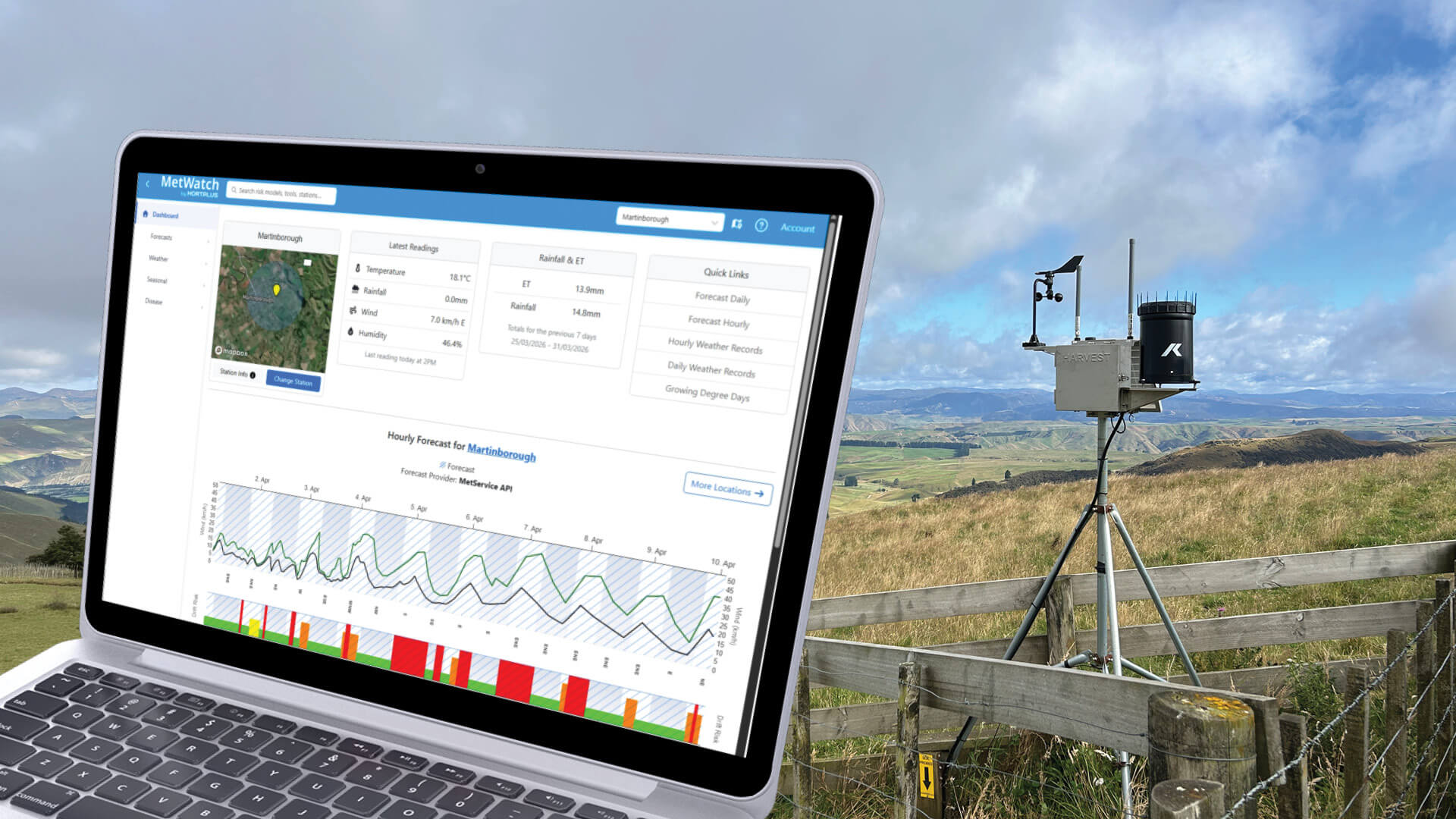
He says digital platforms like the MetWatch crop protection portal can present hour-by-hour risk forecasts for a wide range of plant diseases, including black spot, based on current environmental conditions and forecast weather. By coupling this with information about ideal spray timing, based on near-real-time wind conditions, apple growers can significantly improve the ways they spray.
He says drones are also having an impact by allowing growers to react more quickly to current weather conditions and disease risk indicators, potentially improving their capacity to spray at precisely the right times to maximise crop protection and avoid wastage.

Drone spraying is a developing technology in fruit crop spraying that has the potential to achieve a higher work rate and enable protective fungicide spraying close to a predicted disease event. Responsive spraying in this way in a dry season has the potential to deliver highly effective disease control in a crop like apples with significant reductions in fungicide use compared to current practices.
“Many growers have trapped themselves into intensive ‘no gaps’ fungicide spray programmes because there is zero export market tolerance for some key diseases.
“It’s true that loss of fruit quality and potentially market access is a real financial blow, but loss of chemistry to resistance is a major concern and cost. There’s lots of good things that can come out of spraying only when it’s actually required.”
When adopting an integrated disease management strategy, it was essential to avoid relying solely on fungicides for disease control, Manktelow said Sanitation practices that remove or reduce inoculum pressure could take the pressure off fungicides by reducing the risk of successful infections and slowing pathogen resistance development. Regular and effective orchard inspections to gauge current inoculum load were also vital.
This need for a considered approach to disease management, coupling risk forecasting with inspections and in-season data on inoculum management and spray applications, is echoed by well-known New Zealand plant disease epidemiologist Dr Rob Beresford.
“Risk based spraying requires both the computer models that are available for risk forecasting coupled with structured orchard surveillance at key times to update the disease control strategy as the season progresses,” Beresford said.
Dr Jim Walker – a New Zealand scientist with many years of experience in crop protection research – agrees there is room for more of a risk-based approach to spraying. However, he cautions that it is important that growers fully understand the risks for their specific crops, and the times during the growing season when risk-based spraying is worth considering.
“It depends on the crop you’re talking about and whether you’re talking pest management or disease management. We have good monitoring tools, like pheromone traps, for some of our key pests, but pathogens are more difficult as they are usually driven by weather-related infection events. Some crop diseases lend themselves more to risk-based spraying approaches than others.”
Permanent crops, such as tree fruits – apples, kiwifruit, summerfruit – are all good candidates for more risk-based spraying. However, for some plant diseases, such as black spot in apples, the degree to which a purely risk-data-based spray programme can be adopted depends a lot on the local climate, time of season and rainfall.
“Risks aren’t uniform throughout the season, and there are times of the season when there’s less risk, and you can make the decision based on the data, but at other times you may need to be conservative,” Walker says.
“In a cool and wet maritime climate like New Zealand you have the host-pathogen present for more of the year. In Australia it’s a different equation, especially in drier parts.
“In Western Australia, for example, there’s far less spring rainfall so the risk of inoculum increasing to levels that might cause infection is much lower. This is even more apparent in Washington State in the USA, where relatively dry springs mean that the risk of infection is greatly reduced – indeed many growers take a risk-based approach and take few, if any, measures for control.
“New Zealand has a perfect climate for growing apples but the downside is there are many minor and some major infection periods from bud burst until late November. During this time there are potentially more downsides to risk-based spraying.
“On the backside of that period – in mid-summer – if you are disease free and inoculum free you can afford to reduce spraying and by and large the apple industry does that.”
The risk of getting it wrong isn’t just market access, he says.
“You can easily get 10 to 20 per cent of your crop infected with black spot and at this level, the economics of packing the crop to sort the healthy fruit from infected rapidly becomes impossible.”
In New Zealand, most apple growers spray regularly for black spot, often every 7-14 days during the bud-break to mid-November period, regardless of risk forecasts. This is considered important, because there are usually frequent rainfall events during this primary inoculum release period, often coinciding with rapid leaf growth and fruit expansion. Unprotected foliage or fruit during this time greatly increases the infection risk.
However, even while using this approach in the early season, many growers are still monitoring rain forecasts to ensure they are spraying at optimum times to maintain coverage, as well as wind forecasts, to reduce spray drift on spray-days. When making spray decisions, growers are also accounting for how much new, unprotected growth they have had since they last sprayed.
Walker says growers considering using more of a risk-based approach for black-spot spraying should consider which point of the season they are in, and how much inoculum has already been released. In the early part of the season, those in wetter climates might be wise to be conservative, primarily using risk-based spraying only from December onwards, during the secondary infection period.
Despite all the nuance, and the risk of getting it wrong, Walker says the apple industry has been progressively moving towards more of a risk-based approach over the past few decades – albeit cautiously because few want to risk potential crop loss.
“Before MetWatch came around growers were often blind to infection risks and spray timing was often not well synchronised to those risks . Today a lot of growers are better informed and better understand the seasonal nature of the risk.”
Hawke’s Bay orchardist Roger Brownlie is one of the many growers who has used MetWatch to change the way he sprays on his property, The Orchard. He grows Envy apples as well as summerfruit and uses MetWatch as well as drones to optimise spray timing and coverage.
“Before we had MetWatch we calendar sprayed. So that means we sprayed every week, basically. But now we can actually look at the disease models from MetWatch and see whether it's a nil-risk period. We don't spray at that point. We leave it alone. It gives us an edge in the sense that we can save time and money.”
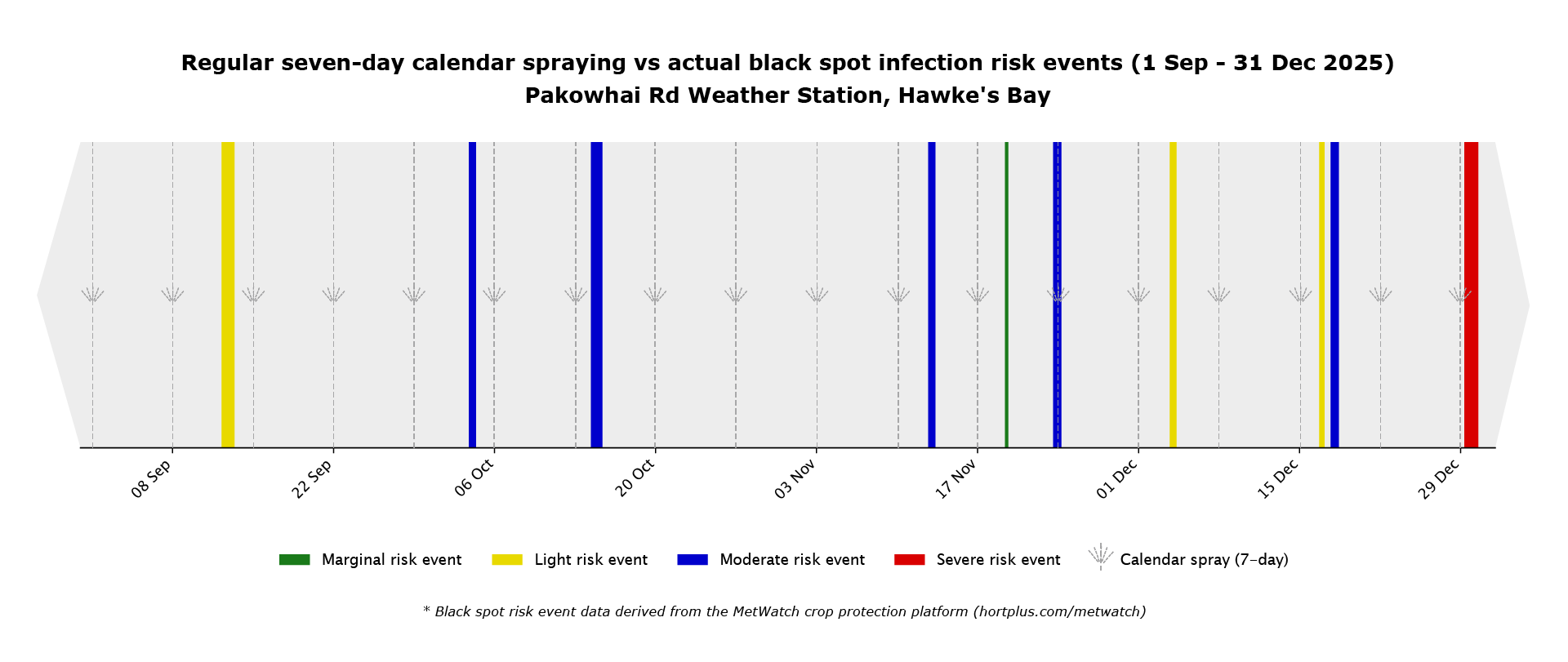
Past research in New Zealand suggests apple growers using risk-based spraying for black spot, rather than calendar spraying, might be able to safely reduce their applications by as much as 18%, depending on seasonal weather.
In practical terms, that might equate to a reduction of four or five spray applications across the year for a grower who previously sprayed for black spot 22-23 times a year.
Protectant sprays cost around $30-$40 a hectare per application. Taking a mid-point of $35 a hectare per protectant black spot spray application, a grower with a 40-hectare apple orchard might save more than $6,000 a year, plus hundreds of litres of diesel, by using a risk-based spraying approach. The savings only increase for growers with larger plantings.
While cost-savings won’t necessarily be the primary driver for most growers adopting more risk-based spraying – the greater benefit comes from better protected crops and more effective disease control – any dollars saved will no doubt be welcome. And if technologies like MetWatch help to make it possible, the argument for a well-informed risk-based spraying approach, at the right times during the growing season, becomes compelling.